Holiday property listings with aerial drone photography receive up to 68% more enquiries than those relying solely on ground-level shots, according to data compiled by real estate marketing analysts. Yet most holiday cottage and hotel owners book a drone shoot without understanding what separates a legally compliant, commercially valuable session from an expensive afternoon of blurry rooftop footage. Before you hire anyone to fly over your Peak District barn conversion or boutique hotel, there are regulations, shot planning decisions, and quality benchmarks you need to understand. This guide covers every one of them.
Table of Contents
- Quick Takeaways
- Why Aerial Drone Photography Matters for Holiday Properties
- UK Drone Regulations: What Every Property Owner Must Know
- What a Professional Drone Shoot Actually Includes
- Peak District-Specific Considerations for Aerial Photography
- How to Evaluate a Drone Photographer Before You Book
- Comparing Drone Photography Approaches for Holiday Properties
- How Aerial Images Integrate with Your Wider Marketing
- Frequently Asked Questions
- References
Quick Takeaways
| Key Insight | Explanation |
|---|---|
| CAA authorisation is non-negotiable for commercial drone work | Any photographer you hire for a paid shoot must hold a valid GVC or A2 CofC licence issued under UK CAA rules. No licence means no legal flight, regardless of how good their portfolio looks. |
| The Peak District National Park has additional flight restrictions | Parts of the Park fall under controlled airspace, and there are sensitive wildlife zones where drone flights require advance permission. A local specialist already knows these boundaries. |
| Golden hour shoots deliver the highest return on investment | Aerial shots taken within 30 minutes of sunrise or sunset show the landscape in warm, directional light that makes moorland, woodland, and stone buildings look dramatically more appealing than flat midday light. |
| Aerial photography alone is not enough | Drone images set the scene and show location, but guests book on interior quality. A combined ground-level and aerial package produces listings that outperform either approach used alone. |
| Insurance must cover third-party liability to at least 1 million GBP | Reputable commercial drone operators carry specialist drone insurance. Ask for the certificate before any flight takes place over your property or guests. |
| Weather windows in the Peak District are short and unpredictable | Professional operators build contingency rebooking into their process. If your photographer does not offer a weather reschedule policy, treat that as a warning sign. |
| Seasonal timing changes what the aerial image shows | Autumn shows vivid moorland colour. Spring shows fresh green valleys. Summer shows accessible walking routes. Choose your shoot date based on the guest profile you want to attract, not just diary convenience. |
Why Aerial Drone Photography Matters for Holiday Properties
Ground-level property photography answers the question: what does the inside look like? Aerial drone property photography answers a completely different and arguably more important question for self-catering owners and hoteliers: where is this place, and why should I care?
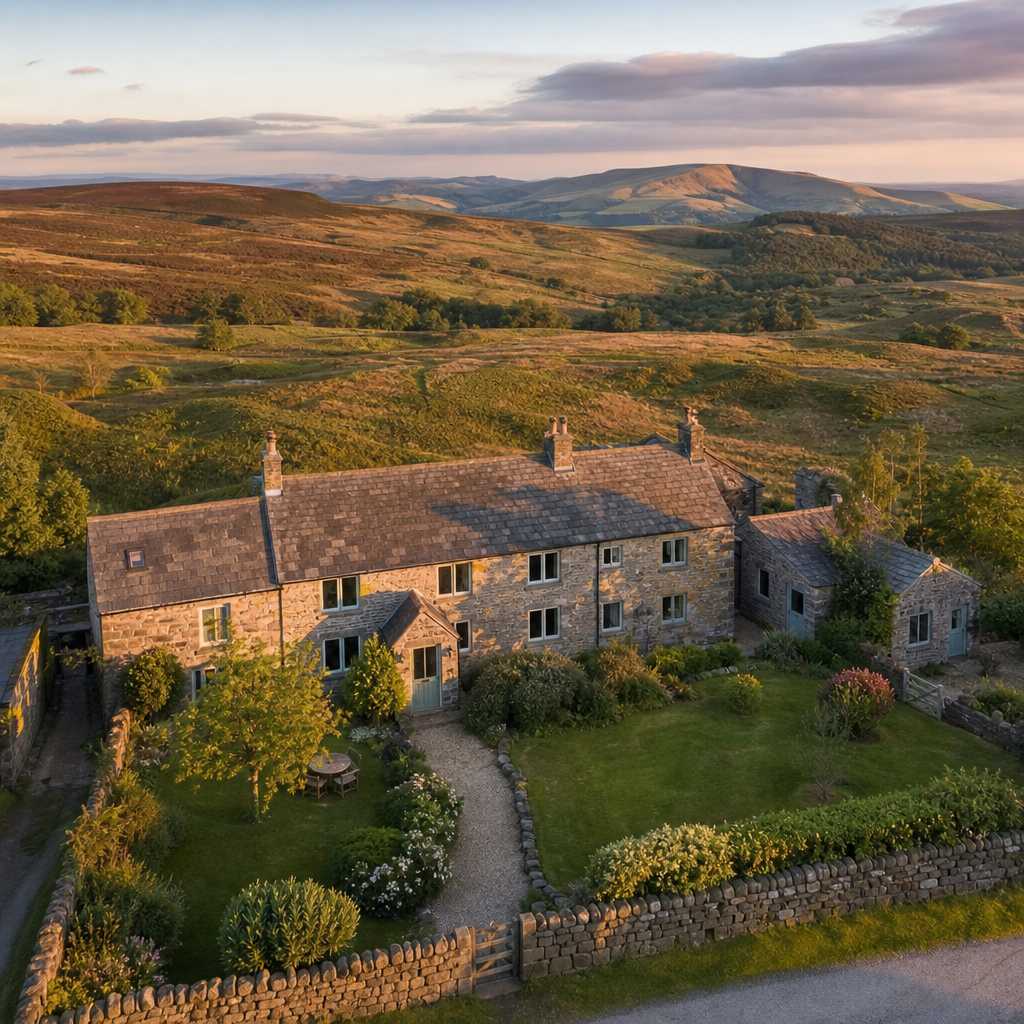
Guests booking a Peak District holiday cottage are not just renting a bedroom and a kitchen. They are buying into a location, a landscape, and an experience. A drone image that shows your stone farmhouse nestled against open moorland, with no other building in sight and a clear walking trail visible in the background, communicates isolation, peace, and authenticity faster than any copywriter ever could.
The data consistently shows that listings using aerial photography achieve higher average booking values, not just more enquiries. Guests who arrive already understanding the true setting of a property leave fewer disappointed reviews about things like road noise or proximity to neighbours. Aerial imagery sets accurate, compelling expectations.


The difference between drone footage and drone stills for property marketing
A common mistake holiday property owners make is assuming moving footage is always more valuable than still images. In practice, high-resolution drone stills are far more versatile for property marketing. They work on booking platforms like Airbnb and Sykes Cottages, in printed brochures, on social media, on your own website, and in press submissions to tourism publications.
Drone video requires hosting, embedding, and viewer attention spans that most browsing guests simply do not give. A single stunning aerial still, used as the hero image on your listing, does more work per second of a guest’s attention than a 90-second fly-through clip. That said, a short aerial sequence can be valuable for a bespoke website or a direct marketing campaign, and the best packages include both.
UK Drone Regulations: What Every Property Owner Must Know
The UK Civil Aviation Authority regulates all commercial drone operations under the UK Air Navigation Order and the CAA’s drone and model aircraft registration and education service (DMARES). Since January 2021, all commercial drone pilots must hold a qualification appropriate to the weight of their drone and the operational category of the flight.
For most property and landscape commercial work, the relevant qualification is either the A2 Certificate of Competency or the General Visual Line of Sight Certificate. The GVC is the more comprehensive of the two and is required for flights closer than 50 metres to uninvolved people or structures. Given that most property shoots involve flying within 50 metres of buildings and occasionally over people, your photographer almost certainly needs a GVC.
What to ask your photographer before you sign a contract
Ask directly for their CAA Operator ID and their pilot qualification certificate. Both should be current. Ask whether they have filed an Operational Authorisation with the CAA for any flights that go beyond standard category permissions, and ask to see their insurance certificate showing commercial drone liability coverage.
If a photographer cannot produce these documents immediately, do not proceed. The consequences of an unregulated drone flight over your property are not theoretical: the CAA issues fines, and if an incident occurs during an unlicensed commercial flight, your own property insurance may refuse to cover any resulting damage claims.
“The UK drone regulatory framework exists to protect the public, property owners, and operators. Compliance is not bureaucratic inconvenience. It is the baseline of professional practice.” – UK Civil Aviation Authority, Drone Safety Guidance
Pro tip: You can verify any UK drone operator’s registration status using the CAA’s public drone operator lookup tool at the Civil Aviation Authority website. Do this before you transfer any deposit.
What a Professional Drone Shoot Actually Includes
Property owners who have never commissioned aerial photography often underestimate how much preparation happens before the drone leaves the ground. A professional shoot is not a matter of arriving on the day and flying around. It involves airspace checks, landowner permissions for any adjacent land the drone passes over, notam (notice to airmen) filing where required, and a detailed shot list agreed in advance.
At Phils Pros On Photography, the preparation process for a Peak District drone shoot includes checking the specific flight zone status of the property location, reviewing any National Park authority restrictions, and planning the optimal approach angles based on the property’s orientation relative to the sun on the shoot date.
Shot types that consistently perform well for holiday property marketing
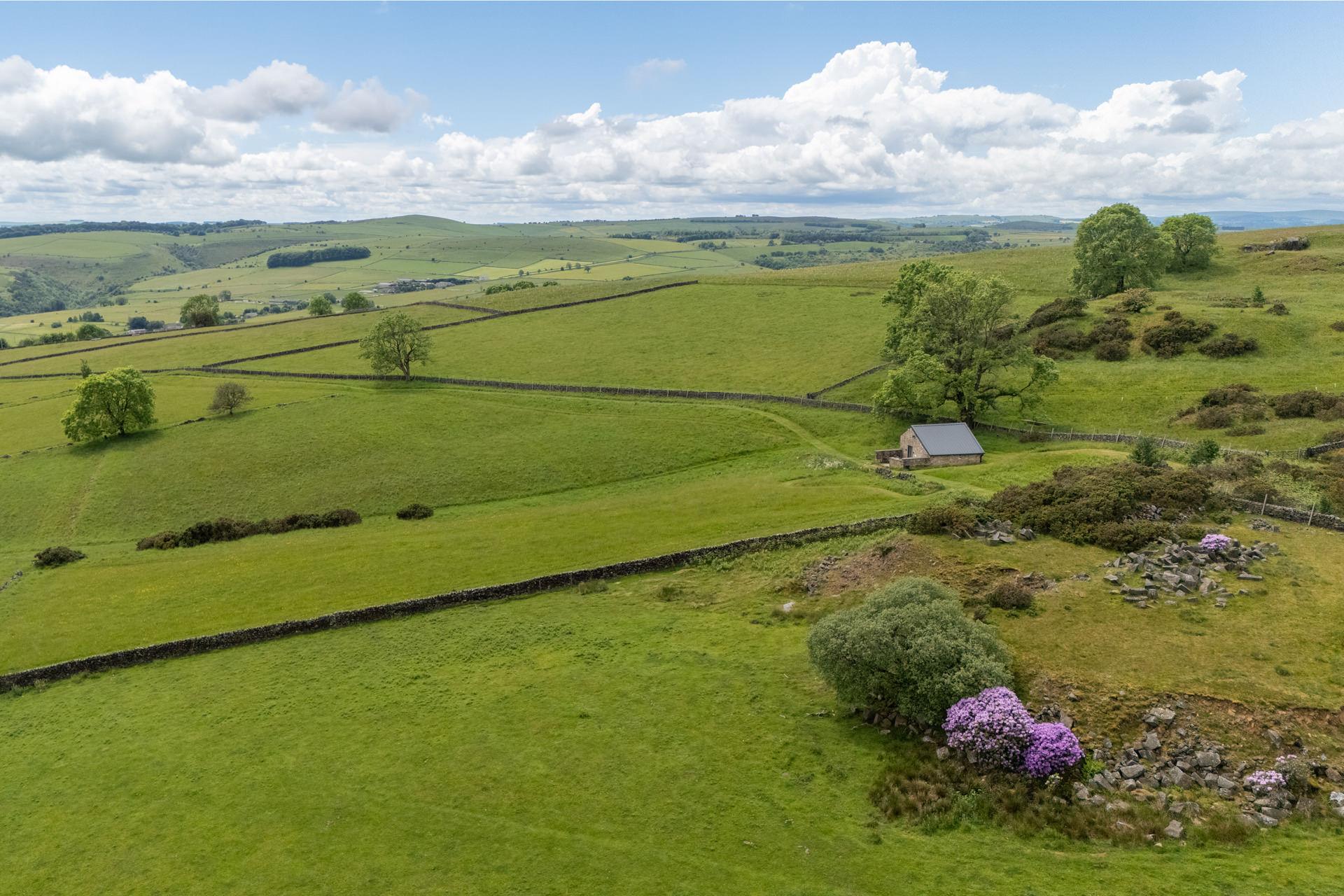
The overhead top-down shot showing the property footprint and its relationship to surrounding landscape is essential. So is the diagonal approach shot, typically from 45 degrees, which gives the viewer a sense of scale and setting simultaneously. A third high-value shot is the wide establishing view from maximum permitted altitude, showing the property within its broader landscape context, particularly useful for properties in the Peak District where the surrounding moorland or valley is itself the selling point.
Close-in detail shots using the drone at lower altitude, showing the garden, terrace, parking, or access track, bridge the gap between aerial and ground-level photography. These are often overlooked but are extremely useful for guests making practical booking decisions.
Pro tip: Always ask to see the raw edited selection of images before the photographer delivers the final cut. Most professional operators edit and deliver 15 to 30 final images from a session. Knowing how many you receive, and in what file formats, avoids disputes after the shoot.

Peak District-Specific Considerations for Aerial Photography
The Peak District is not a uniform flying environment. The National Park covers approximately 555 square miles and includes areas of controlled airspace, military low-flying zones, and designated Sites of Special Scientific Interest where drone flights can disturb nesting birds and trigger access restrictions under the Wildlife and Countryside Act 1981.
Practically, this means a photographer unfamiliar with the specific location of your property may arrive without the necessary permissions or may be unaware of a no-fly restriction that applies within your postcode zone. A specialist in Peak District aerial photography already has this knowledge, has likely flown near your location before, and can advise whether any additional permissions are needed before the shoot date.
How seasonal conditions affect aerial drone photography in the Peak District
The Peak District’s weather is genuinely variable throughout the year, and the aesthetic result of a drone shoot changes dramatically by season. Heather moorland peaks in colour during late August and September, producing the purple-and-amber landscape that is visually iconic for the region. This is the best time to capture properties on or near moorland, and the imagery produced during this window has a noticeably higher impact on booking enquiries for autumn and winter stays.
Winter shoots, particularly after light snowfall, produce striking images for luxury cottage operators targeting high-value short breaks. Spring shoots with bluebells in woodland valleys can be highly effective for cottages marketed toward families and walkers. The key principle: choose your shoot date based on what your ideal guest finds compelling, not simply when it is convenient for you.
How to Evaluate a Drone Photographer Before You Book
The Peak District has several photographers operating in the commercial space, and not all of them have equivalent skills, equipment, or local knowledge. Evaluating a drone photographer before booking requires looking beyond a glossy website portfolio.
Start with the licensing and insurance questions already covered. Then look at the specific aerial work in their portfolio. Do the drone images show consistent exposure control? Are the horizons level? Is the colour grading sympathetic to the landscape rather than over-processed? In practice, heavily saturated, artificially blue-sky drone images often look impressive on first glance and perform poorly on booking platforms, where guests are looking for an authentic sense of place rather than a retouched fantasy.
Questions to ask during an initial conversation
Ask what drone equipment they use and why. A professional operating a DJI Mavic 3 Pro or equivalent produces noticeably sharper, more colour-accurate results than someone flying an older consumer-grade drone. Ask how they handle weather cancellations and what their rescheduling policy is. Ask whether they shoot in RAW format and edit the files themselves, or deliver straight-from-camera JPEGs. The answer tells you a great deal about their professional standards.
Ask specifically whether they have flown near your property’s postcode before and what airspace restrictions apply there. A photographer who confidently answers this question is someone who has done their homework on your location. One who answers vaguely is someone you may be educating on the day of the shoot, which is not a position you want to be in.
Comparing Drone Photography Approaches for Holiday Properties
Not every aerial photography brief is the same, and the right approach depends on your property type, your marketing channels, and your budget. The table below compares the three most common approaches used for holiday property aerial photography in the Peak District market.
| Approach | Best Suited For | Limitations |
|---|---|---|
| Standalone drone stills package | Owners updating a listing on Airbnb, Sykes, or their own site with a focused aerial perspective. Fast turnaround, lower cost entry point, maximum versatility across platforms. | Does not cover interior quality, which remains the primary booking driver for most guests. Works best as a complement to an existing strong interior photography set. |
| Combined aerial and ground-level property shoot | New properties launching to market, properties rebranding after renovation, hotels and larger hospitality businesses needing a complete image library. The most commercially complete option. | Requires a full day or more depending on property size. Higher investment but delivers a cohesive set of images that works across every marketing channel simultaneously. |
| Destination and landscape aerial package | Tourism boards, visitor attractions, and destination marketing organisations needing wide-area aerial imagery of the Peak District landscape for campaign use. Also useful for holiday property owners with exceptional natural settings who want images that transcend a single listing. | Requires the most advance planning including multiple location permits, longer shoot windows, and specialist post-processing. Not appropriate for straightforward property listing refreshes. |
How Aerial Images Integrate with Your Wider Marketing
Aerial drone property photography does not exist in isolation. The images you commission should be planned from the outset to work across the full range of channels where your property appears. This includes your listing on third-party booking platforms, your own direct booking website, your social media presence, and any printed materials you produce.
On platforms like Airbnb and Booking.com, the primary image carousel is the first thing a prospective guest sees. An aerial shot used as the hero image consistently outperforms interior shots in click-through rate tests, because it communicates uniqueness and setting before the guest has read a single word of the description. HubSpot’s research on visual content performance confirms that images communicating context and emotion outperform product-only visuals in travel and hospitality sectors.
Using aerial images on a direct booking website
If your property has its own direct booking website, the aerial image belongs on the homepage as the full-width hero. It should be optimised for web use with a descriptive file name and alt text that reflects the location and property type, for example “stone holiday cottage surrounded by Peak District moorland”. This is a meaningful, practical contribution to your site’s local search visibility for terms like drone photography holiday cottage and related queries.
At Phils Pros On Photography, property website design services are offered specifically for holiday rental and hospitality businesses, meaning your aerial images can be integrated professionally into a site built to convert organic search traffic into direct bookings. This end-to-end approach, from commission to publication, eliminates the common problem of excellent images displayed badly on an outdated or poorly structured website.
Aerial images in print and retail contexts
For tourism boards and destination marketing organisations, aerial Peak District photography has value well beyond the digital channel. High-resolution drone images of iconic landscapes can be reproduced as large-format prints, used in visitor guides, featured on greeting cards and calendars sold through retail channels, or submitted to national travel press. The print and retail side of the photography business exists precisely because the best aerial landscape work has inherent commercial value beyond any single campaign.
Frequently Asked Questions
Do I need to give permission for a drone to fly over my property?
As the property owner or occupier, you are the relevant landowner whose permission is required for a commercial drone flight that takes off or lands on your land. The drone photographer does not need separate planning permission to fly in airspace, but they do need your written consent and must comply with CAA regulations throughout the flight. If the drone will fly over adjacent land not owned by you, the operator may need to seek additional permissions from neighbouring landowners depending on the flight path.
How much does a professional drone property shoot cost in the Peak District?
Expect to pay between 200 GBP and 600 GBP for a standalone aerial stills package from a qualified, insured professional in the Peak District. Combined ground-level and aerial packages typically start from 400 GBP and increase with property size and shoot complexity. Avoid any operator quoting significantly below this range for commercial work. Below-market pricing almost always reflects absent insurance, missing qualifications, or inadequate equipment that will be visible in the final images.
What weather conditions are needed for a drone shoot?
Commercial drones can operate in light wind conditions up to approximately 20 mph, though most professional operators prefer calmer conditions for precision work around structures. Rain grounds most consumer and prosumer drones immediately. Low cloud and fog both reduce the value of aerial images, as the landscape context disappears into grey. In practice, the Peak District requires genuine flexibility around shoot dates, and any professional package should include at least one weather-contingency reschedule at no extra charge.
Will my booking platform accept aerial drone photography?
Yes. Airbnb, Sykes Cottages, Holidaycottages.co.uk, and all major platforms accept high-resolution drone still images uploaded in the same way as ground-level photography. There are no platform restrictions on aerial images, provided they are not deceptive or misleading about the property. Ensure your images are delivered in JPEG format at a minimum of 1920 pixels on the longest edge for platform use, and retain the full-resolution originals for print and web use.
Is aerial photography worth the investment for a single small cottage?
Yes, with one important condition: the setting has to be genuinely distinctive. If your cottage sits in a terraced row in a town centre, aerial photography adds little marketing value. If it sits alone on a hillside, overlooks a reservoir, or is surrounded by open moorland, an aerial shot communicates that value instantly in a way no ground-level image can. For Peak District properties specifically, where the landscape is the primary draw for most guests, aerial photography almost always delivers a measurable return through higher enquiry volume and stronger direct booking rates.
How long does it take to receive the final edited images after a drone shoot?
A professional operator typically delivers a final edited selection within five to ten working days of the shoot. Rush delivery can usually be arranged for an additional fee if you have a listing launch deadline. Always agree the delivery timeline, file formats, and number of final images in writing before the shoot takes place. This protects both you and the photographer from post-shoot disputes about expectations.
If you have booked aerial drone photography for your own Peak District property or worked with a drone photographer as part of a tourism marketing campaign, share what made the difference between a shoot that delivered and one that fell short. Your experience is useful to other property owners making this decision.
References
- UK Civil Aviation Authority drone regulations, operator registration requirements, and airspace guidance for commercial operators
- Statista data on travel and hospitality booking behaviour and the influence of visual content on guest decision-making
- HubSpot research on visual content performance in travel and hospitality marketing contexts
- Forbes coverage of drone technology adoption in real estate and short-term rental property marketing
- Moz guidance on image optimisation best practices for local search visibility in property and tourism sectors